Biological Classification — DPP 14

20 NEET questions from Biological Classification, with answers and explanations. Attempt it as a timed test to get scoring, accuracy breakdown and mistake tracking.

Attempt this test free 20 questions · 30 minutes · +80 marks
1
Select the correct statements below that correctly apply to the kingdom fungi :-
  1. A Some fungi form beneficial interrelationships with plants.
  2. B Certain fungi are natural source of antibiotics.
  3. C The fungal life cycle typically includes a spore stage.
  4. D All
Show answer

Correct answer: D
2
"Fire algae" belongs to group :-
  1. A Pyrrophyta
  2. B Chrysophyta
  3. C Euglenophyta
  4. D Rhodophyta
Show answer

Correct answer: A

3
Choose the incorrect statement about ascomycetes :-
  1. A Mycelium is branched and septate.
  2. B Sexual spores are produced endogenously.
  3. C They have sac like structure in which karyogamy takes place.
  4. D Reduction division occurs in fruiting bodies and form conidia.
Show answer

Correct answer: D

4
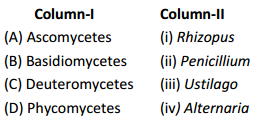
Match column I with column II and choose the right option :
Biological Classification – NEET-1492
  1. A A-(iv), B-(iii), C-(i), D-(ii)
  2. B A-(ii), B-(iii), C-(iv), D-(i)
  3. C A-(iv), B-(i), C-(ii), D-(iii)
  4. D A-(iii), B-(iv), C-(ii), D-(i)
Show answer

Correct answer: B

5
Choose the incorrect statement about phycomycetes :-
  1. A Members are found in aquatic habitats
  2. B Spores are endogenously produced in sporangium
  3. C Zygospore is formed by reduction division
  4. D Its members reproduce sexually may be isogamous, anisogamous or oogamous.
Show answer

Correct answer: C

6
In oogamy, fertilization involves :-
  1. A A large motile female gamete and a small non-motile male gamete
  2. B A small non-motile female gamete and a large motile male gamete
  3. C A large non-motile female gamete and a small motile male gamete
  4. D A large non-motile female gamete and a large non-motile male gamete
Show answer

Correct answer: C

7
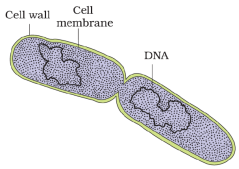
This diagram represents which of the following organism?
Biological Classification – NEET-1888

  1. A Slime mould
  2. B Euglena
  3. C Dividing fungi
  4. D Dividing bacterium
Show answer

Correct answer: D

8
Ergot fungi belongs to :-
  1. A Ascomycetes
  2. B Basidiomycetes
  3. C Phycomycetes
  4. D Deuteromycetes
Show answer

Correct answer: A

9
The mode of the nutrition of bacteria is usually
  1. A Photo autotrophic
  2. B Chemo autotrophic
  3. C Heterotrophic and autotrophic
  4. D None
Show answer

Correct answer: C

10
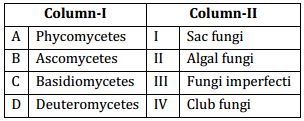
Match the following -
Biological Classification – NEET-1902
  1. A A - II, B - I, C - IV, D - III
  2. B A - II, B - IV, C - I, D - III
  3. C A - IV, B - I, C - II, D - III
  4. D A - IV, B - III, C - II, D - I
Show answer

Correct answer: A

11
If mesosomes of a bacterium are removed then :-
  1. A Bacteria will not be able to repair its damaged cell wall
  2. B Bacteria will fail to undergo division
  3. C Bacteria will fail in aerobic respiration
  4. D All the above
Show answer

Correct answer: D

12
List some of the fungi is given below: Mucor, Rhizopus, Albugo, Aspergillus, Penicillium, Puccinia, Ustilago. In how many fungi, plasmogamy is followed by karyogamy, immediately: -
  1. A Two
  2. B Three
  3. C Four
  4. D Five
Show answer & explanation

Correct answer: B

Mucor, Rhizopus & Albugo (In members of phycomycetes)
13
In prokaryotes, chromatophores are -
  1. A Specialized granules responsible for colouration of cells
  2. B Structures responsible for organizing the shape of the organism
  3. C Inclusion bodies lying free inside the cells for carrying out various metabolic activities
  4. D Internal membrane systems that may become extensive and complex in photosynthetic bacteria
Show answer

Correct answer: D

14
Which of the following performs respiration with the help of plasma membrane ?
  1. A Bacteria
  2. B Algae
  3. C Fungi
  4. D All the above
Show answer

Correct answer: A

15
In which of the following the cell wall has stiff outer surface :-
  1. A Dinoflagellates
  2. B Desmids
  3. C Diatoms
  4. D Euglenoids
Show answer

Correct answer: A

16
Citric acid is obtained from :-
  1. A Streptomyces
  2. B Aspergillus
  3. C Penicillium
  4. D Albugo
Show answer

Correct answer: B

17
Carbohydrates, the most abundant biomolecules on earth, are produced by :
  1. A some bacteria, algae and green plant cells
  2. B all bacteria, fungi and algae
  3. C fungi, algae and green plant cells
  4. D viruses, fungi and bacteria
Show answer

Correct answer: A

18
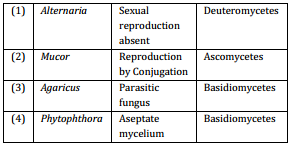
Which one of the following matches is correct?
Biological Classification – NEET-1617
  1. A Alternaria - Sexual reproduction absent - Deuteromycetes
  2. B Mucor - Reproduction by Conjugation - Ascomycetes
  3. C Agaricus - Parasitic fungus - Basidiomycetes
  4. D Phytophthora - Aseptate mycelium - Basidiomycetes
Show answer

Correct answer: A

19
Bacteria participate in -
  1. A Many industrial and commercial processes.
  2. B $\mathrm { N } _ { 2 }$-fixation in legume roots.
  3. C Disease producing in plants, animals and human beings.
  4. D All of these.
Show answer

Correct answer: D

20
Which organisms have silica in their cell wall?
  1. A Dinoflagellates
  2. B Slime mould
  3. C Diatoms
  4. D Euglenoids
Show answer

Correct answer: C

Attempt this as a timed test

Reading answers is not the same as sitting the paper. Attempt it timed and you get your score, per-question timing, and the mistakes tracked for revision.

Start free

More Biological Classification tests

All Biological Classification questions & tests →