Cell The Unit Of Life — DPP 10

20 NEET questions from Cell The Unit Of Life, with answers and explanations. Attempt it as a timed test to get scoring, accuracy breakdown and mistake tracking.

Attempt this test free 20 questions · 30 minutes · +80 marks
1
Match the following:
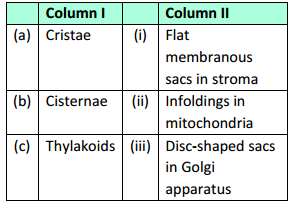
Cell The Unit Of Life – NEET-2558
  1. A (a)-(ii), (b)-(iii), (c)-(i)
  2. B (a)-(ii), (b)-(i), (c)-(iii)
  3. C (a)-(iii), (b)-(ii), (c)-(i)
  4. D (a)-(i), (b)-(iii), (c)-(ii)
Show answer

Correct answer: A
2
Basal body is :-
  1. A Centriole like
  2. B Plastid like
  3. C Ribosome like
  4. D Mitochondria like
Show answer

Correct answer: A

3
Polysome is formed by: -
  1. A A ribosome with several subunits
  2. B Ribosomes attached to each other in a linear arrangement
  3. C Several ribosomes attached to a single mRNA
  4. D Many ribosomes attached to a strand of endoplasmic reticulum
Show answer

Correct answer: C

4
ATP factories of cells are -
  1. A Chloroplast
  2. B Mitochondria
  3. C Ribosome
  4. D Nucleus
Show answer

Correct answer: B

5
Chromosome, which has centromere slightly away from the middle of the chromosome resulting into one shorter arm and one longer arm, is called -
  1. A Submetacentric
  2. B Acrocentric
  3. C Metacentric
  4. D Telocentric
Show answer

Correct answer: A

6
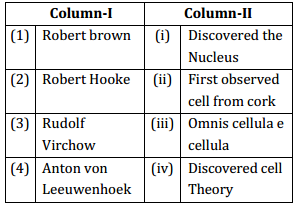
Match the columns I & II and identify the incorrect option :-
Cell The Unit Of Life – NEET-2773
  1. A & Robert brown & (i) & \begin{tabular} { l } Discovered the \\ Nucleus \end{tabular} \\ \hline
  2. B & Robert Hooke & (ii) & \begin{tabular} { l } First observed \\ cell from cork \end{tabular} \\ \hline
  3. C & \begin{tabular} { l } Rudolf \\ Virchow \end{tabular} & (iii) & \begin{tabular} { l } Omnis cellula e \\ cellula \end{tabular} \\ \hline
  4. D & \begin{tabular} { l } Anton von \\ Leeuwenhoek \end{tabular} & (iv) & \begin{tabular} { l } Discovered cell \\ Theory \end{tabular} \\ \hline \end{tabular}
Show answer

Correct answer: D

7
Which of the following is not dependent upon fluidity of cell membrane?
  1. A Selective permeability
  2. B Endocytosis
  3. C Secretion
  4. D Cell growth
Show answer

Correct answer: A

8
Mitochondria are believed to be of symbiotic origin from bacteria because they have similarity with bacteria in :-
  1. A DNA
  2. B Ribosomes
  3. C Division method
  4. D All of the above
Show answer

Correct answer: D

9
Mitochondria and chloroplasts hav membranes yet they are not the part endomembrane system because :-
  1. A Their membranes are thin as compare t the membranes of ER & Golgi body.
  2. B They have two membranes each where a endomembrane system has on membrane
  3. C Their functions are not coordinated witl the ER, golgi body and Lysosomes
  4. D They originated from prokaryotic cells
Show answer

Correct answer: C

10
Read the following statements with respect to mitochondria:-
(i) It divides and increases its number by binary fission.
(ii) During the early course of evolution these were prokaryotes.
(iii) Its matrix performs electron transport chain, and the inner membrane performs Kreb's cycle.
(iv) These are fully autonomous organelles.
(v) Its matrix possess 70 S ribosomes, RNA and linear dsDNA.
How many of the above statements are correct?
  1. A Three
  2. B Two
  3. C Four
  4. D Five
Show answer

Correct answer: B

11
Mitochondria :-
(a) are easily visible under the microscope (without specifically stained)
(b) are typically sausage-shaped or cylindrical
(c) are double membrane bound structures
(d) have two aqueous compartments
  1. A a, d correct and b, c incorrect
  2. B a, b correct and c, d incorrect
  3. C a incorrect and b, c, d correct
  4. D a, d incorrect and b, c correct
Show answer

Correct answer: C

12
Which one of the following is correct?
(a) Nuclear matrix or nucleoplasm contains nucleolus and chromatin.
(b) Outer nuclear membrane usually remains continuous with the ER and also bears ribosomes on it.
(c) Small and lesser number of nucleoli are present in cells actively carrying out protein synthesis.
(d) Perinuclear space forms a barrier between the materials present inside the nucleus and that of the cytoplasm.
  1. A a and b
  2. B a, b and d
  3. C a, b, c and d
  4. D b, c and d
Show answer

Correct answer: A

13
........can not pass through the lipid bilayer, they require a carrier protein of the membrane to facilitate their transport across the membrane
  1. A Nonpolar molecules
  2. B Polar molecules
  3. C Hydrophobic molecules
  4. D Both (B) and (C)
Show answer

Correct answer: B

14
Which similarity is found between chloroplast and mitochondria?
  1. A Both are semi-autonomous contain double stranded circular DNA and double membrane bound.
  2. B Both are autonomous organelle.
  3. C Both are single membrane bounded.
  4. D Both contains 80 S type of ribosome.
Show answer

Correct answer: A

15
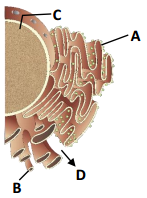
Identify the components labelled A, B, C and D in the diagram below from the list (i) to (viii) given with -
Cell The Unit Of Life – NEET-2699Components:
(i) Cristae of mitochondria
(ii) Inner membrane of mitochondria
(iii) Cytoplasm
(iv) Smooth endoplasmic reticulum
(v) Rough endoplasmic reticulum
(vi) Mitochondrial matrix
(vii) Cell vacuole
(viii) Nucleus
The correct component are:
  1. A A–(i), B–(iv), C–(viii), D–(vi)
  2. B A–(vi) B–(v), C–(iv), D–(vii)
  3. C A–(v), B–(i), C–(iii), D–(ii)
  4. D A–(v), B–(iv), C–(viii), D–(iii)
Show answer

Correct answer: D

16
Peri-plastidial space is found in:
  1. A Between two membranes of a chloroplast
  2. B Between two thylakoids
  3. C Between two inter-grana lamellae
  4. D Between two chloroplasts of a cell
Show answer

Correct answer: A

17
Polysome is a chain of :-
  1. A Pinosomes
  2. B Phagosomes
  3. C Microsomes
  4. D Ribosomes
Show answer

Correct answer: D

18
Which properties differentiate animal and plant cell :- (a) Presence of cell wall (b) Small size vacuole (c) Plastid (d) Centriole
  1. A All
  2. B a, b
  3. C a, b, c
  4. D a, c, d
Show answer

Correct answer: D

19
Lysosome arises from which cell organelle?
  1. A Nucleus
  2. B Endoplasmic reticulum
  3. C Golgi Apparatus
  4. D Both (B) and (C)
Show answer

Correct answer: D

20
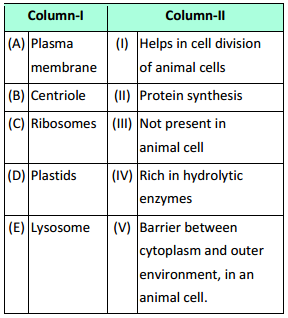
Match the column I and II and choose correct option :-
Cell The Unit Of Life – NEET-2681
  1. A $\mathrm { A } - \mathrm { V }, \mathrm { D } - \mathrm { I }, \mathrm { C } - \mathrm { II }, \mathrm { A } - \mathrm { III }, \mathrm { E } - \mathrm { IV }$
  2. B $\mathrm { A } - \mathrm { V } , \mathrm { B } - \mathrm { III } , \mathrm { C } - \mathrm { II } , \mathrm { D } - \mathrm { I } , \mathrm { E } - \mathrm { IV }$
  3. C $\mathrm { A } - \mathrm { IV } , \mathrm { B } - \mathrm { III } , \mathrm { C } - \mathrm { II } , \mathrm { D } - \mathrm { I } , \mathrm { E } - \mathrm { V }$
  4. D $\mathrm { A } - \mathrm { II } , \mathrm { B } - \mathrm { IV } , \mathrm { C } - \mathrm { III } , \mathrm { D } - \mathrm { I } , \mathrm { E } - \mathrm { V }$
Show answer

Correct answer: A

Attempt this as a timed test

Reading answers is not the same as sitting the paper. Attempt it timed and you get your score, per-question timing, and the mistakes tracked for revision.

Start free

More Cell The Unit Of Life tests

All Cell The Unit Of Life questions & tests →