Human Reproduction — DPP 1

20 NEET questions from Human Reproduction, with answers and explanations. Attempt it as a timed test to get scoring, accuracy breakdown and mistake tracking.

Attempt this test free 20 questions · 30 minutes · +80 marks
1
Which of the following cells secrete testicular hormones called androgens and form endocrine part of the testis?
  1. A Leydig cells
  2. B Interstitial cells
  3. C Sertoli cells
  4. D Both (1) & (2)
Show answer & explanation

Correct answer: D

Leydig cells are also called interstitial cells because they are present in the interstitial space between the seminiferous tubules and they secrete androgens (testosterone).
2
Why it is scientifically correct to say that sex of the baby is determined by the father and not by the mother?
  1. A Human female produces two types of gametes
  2. B Human male produces one type of gametes
  3. C Human female is XX, whereas male is XY, 50 percent of sperms carry the X chromosome while other 50% carry Y chromosome
  4. D All of these
Show answer & explanation

Correct answer: C

Due to heterozygosity in male sex chromosomes (XY), the sex of baby is decided by the kind of sperm (having X or Y) approaching female ovum (which has X).
3
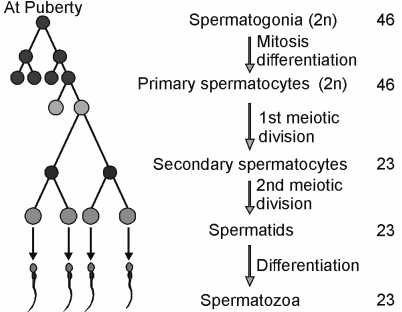
In humans, at the end of the first meiotic division, the male germ cells form
  1. A Spermatogonia
  2. B Primary spermatocytes
  3. C Secondary spermatocytes
  4. D Spermatids
Show answer & explanation

Correct answer: C

Human Reproduction – NEET-9383
4
Sertoli cells are found in
  1. A Ovaries and secrete progesterone
  2. B Testes and secrete testosterone
  3. C Seminiferous tubules and after spermiogenesis, sperm heads become embedded in them
  4. D Adrenal cortex and secrete adrenaline
Show answer & explanation

Correct answer: C

Sertoli cells are also known as sustentacular or nurse cells.
5
In the fertile human female, approximately on which day of the menstrual cycle (32 days) does ovulation take place?
  1. A Day 18
  2. B Day 14
  3. C Day 1
  4. D Day 8
Show answer & explanation

Correct answer: A

The ovulation occurs 14 days before the completion of one menstrual cycle, hence, $32 - 14 = 18$ i.e. $18 ^ { \text {th } }$ days.
6
Primary sex organs differ from the secondary sex organs in all the following, except
  1. A They produce gametes
  2. B They secrete sex hormones
  3. C They are concerned with the conduction of gametes
  4. D Testes in male and ovaries in female are the examples of primary sex organs
Show answer & explanation

Correct answer: C

Conduction of gametes is function of secondary sex organs.
7
Male accessory glands include
  1. A Paired seminal vesicles
  2. B A prostate gland
  3. C Paired bulbourethral gland
  4. D All of these
Show answer & explanation

Correct answer: D

Bulbourethral glands (= Cowper's glands) and seminal vesicles are paired and prostate gland is unpaired.
8
Choose the odd one w.r.t. external genitalia of a female
  1. A Cervix
  2. B Clitoris
  3. C Hymen
  4. D Mons pubis
Show answer & explanation

Correct answer: A

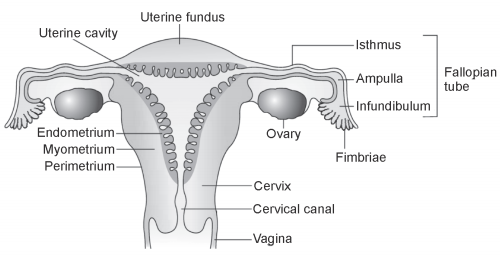
Cervix is part of uterus (womb) which is part of internal reproductive structures.
9
Trophoblast, is not involved in the formation of
  1. A Protective and trophic membranes
  2. B Foetal portion of placenta
  3. C Body of developing embryo
  4. D Chorionic villi
Show answer & explanation

Correct answer: C

Body of developing embryo is formed by inner cell mass.
10
The largest part of the fallopian tube is
  1. A Infundibulum
  2. B Isthmus
  3. C Ampulla
  4. D Cervix
Show answer & explanation

Correct answer: C

Human Reproduction – NEET-9380
11
The stem cells which have potency to give rise to all tissues and organs are formed from
  1. A Trophoblast
  2. B Umbilical cord
  3. C Inner cell mass
  4. D Placenta
Show answer & explanation

Correct answer: C

Stem cells in inner cell mass form primary germinal layers.
12
After ovulation Graafian follicle transforms into
  1. A Corpus luteum
  2. B Corpus albicans
  3. C Corpus callosum
  4. D Follicular atresia
Show answer & explanation

Correct answer: A

During luteal phase (after ovulation), the remaining parts of the Graafian follicle transform as corpus luteum.
13
Placenta acts as an endocrine tissue and produces several hormones like
A. Human chorionic gonadotropin (hCG)
B. Human placental lactogen (hPL)
C. Estrogens
D. Progesterone
  1. A A & B
  2. B B only
  3. C A, B & C
  4. D A, B, C & D
Show answer & explanation

Correct answer: D

hCG and hPL are exclusively produced by placenta

hCG is functionally similar to LH.
14
Hormone responsible for release of milk by mammary glands is
  1. A Estrogen
  2. B hPL
  3. C Prolactin
  4. D Oxytocin
Show answer & explanation

Correct answer: D

Oxytocin is also called milk letdown hormone. Prolactin helps in formation of milk by mammary alveoli.
15
In human female, the blastocyst
  1. A Forms placenta even before implantation
  2. B Gets implanted in the uterus 3 days after ovulation
  3. C Gets implanted in the endometrium by trophoblast cells
  4. D The trophoblast cells get differentiated as the embryo
Show answer & explanation

Correct answer: C

After implantation, chorionic villi and uterine tissue become interdigitated with each other and jointly form placenta.

Blastocyst gets implanted in the uterus about 7 days after fertilization.

Inner cell mass gets differentiated into embryo.
16
Vas deferens receives a duct from seminal vesicle and opens into urethra as
  1. A Urethral meatus
  2. B Ejaculatory duct
  3. C Ureter
  4. D Epididymis
Show answer & explanation

Correct answer: B

Path of sperm Human Reproduction – NEET-9376

17
The Graafian follicle ruptures to release ________ from the ovary by the process called ovulation.
  1. A Primary oocyte
  2. B Secondary oocyte after completing meiosis-II
  3. C Secondary oocyte after completing meiosis-I and with the release of $1^{\text {st }}$ polar body
  4. D Mature ovum
Show answer & explanation

Correct answer: C

There is unequal division of cytoplasm. Secondary oocyte is arrested at metaphase-II and meiosis-II is completed only after the entry of sperm.
18
Read the following paragraph with two blanks : Each testis has about A compartments called testicular lobules. Each lobule contains
B highly coiled seminiferous tubules in which the sperms are produced. The correct option for the two blanks is
  1. A
  2. B
  3. C
  4. D
Show answer & explanation

Correct answer: C

Seminiferous tubules are site for spermatogenesis.
19
Why the testes in human beings and mammals are situated outside the abdominal cavity within a pouch called scrotum?
  1. A There is not enough space in the pelvic area for the testicles to be housed internally
  2. B The scrotum helps in maintaining the low temperature of testes, $2.5 ^ { \circ } \mathrm { C }$ lower than normal body temperature required for spermatogenesis
  3. C The scrotum helps in maintaining the high temperature of testis, $2.5 ^ { \circ } \mathrm { C }$ higher than the normal body temperature required for spermatogenesis
  4. D Providing more space for the growth of epididymis
Show answer & explanation

Correct answer: B

Testes are extra-abdominal because for spermatogenesis, temperature required is $2.5 ^ { \circ } \mathrm { C }$ lower than normal body temperature.
20
Signals from fully developed foetus and placenta ultimately lead to parturition which requires the release of
  1. A Progesterone from placenta
  2. B Oxytocin from maternal pituitary
  3. C Cortisol from foetal pituitary
  4. D Relaxin from Sertoli cells
Show answer & explanation

Correct answer: B

Oxytocin causes uterine contractions leading to child birth. Relaxin is released from corpus luteum.

Attempt this as a timed test

Reading answers is not the same as sitting the paper. Attempt it timed and you get your score, per-question timing, and the mistakes tracked for revision.

Start free

More Human Reproduction tests

All Human Reproduction questions & tests →