Human Reproduction — DPP 4

20 NEET questions from Human Reproduction, with answers and explanations. Attempt it as a timed test to get scoring, accuracy breakdown and mistake tracking.

Attempt this test free 20 questions · 30 minutes · +80 marks
1
If both ovaries are removed from pregnant human female in first trimester of pregnancy then it will lead to
  1. A Abortion
  2. B Normal development
  3. C Irregular ovulation no fixed time interval
  4. D Menarche
Show answer & explanation

Correct answer: A

In first trimester, corpus luteum is required for the production of progesterone (the pregnancy hormone), however, after first trimester, placenta secretes sufficient progesterone. Removal of ovary in first trimester leads to loss of corpus luteum.
2
The fluid that is secreted from mammary glands first few days after parturition is called
  1. A Neonatal milk
  2. B Colostrum
  3. C Cholesterol
  4. D Chyle
Show answer & explanation

Correct answer: B

Witch's milk or neonatal milk is secreted from the breasts of some newborn human infants of either sex.
3
Given below are four statements (A - D) each with one or two blanks. Select the option which correctly fill up the blanks in two statements :
A. The human male ejaculates about (i) million sperms during a coitus. Out of which, for normal fertility at least (ii) percent sperms must have normal shape and size.
B. A primary spermatocyte completes (i) meiotic division leading to the formation of two equal haploid cells called (ii).
C. Spermatogenesis starts at the age of (i) due to significant increase in the secretion of (ii) a hypothalamic hormone.
D. Oogenesis is initiated during embryonic development and at puberty only (i) primary follicles are left in each ovary.


  1. A A - (i) : 200 to 300 ; (ii) 40, B - (i) : Second; (ii) Spermatids
  2. B A - (i) : 200 to 300 ; (ii) 40, D - (i) : 60,000 to 80,000
  3. C B - (i) : First; (ii) Secondary spermatocytes, C - (i) : Puberty; (ii) GnRH
  4. D C - (i) : Puberty; (ii) Gonadotropins, D - (i) : 60,000 to 80,000
Show answer & explanation

Correct answer: C

A (i) 200-300 million sperms; (ii) 60
B (i) First; (ii) Secondary spermatocyte
C (i) Puberty; (ii) GnRH
D (i) 60,000 to 80,000
4
During menstrual cycle, the cyclic changes in the primate uterus are caused by hormones from
  1. A Anterior pituitary
  2. B Ovary
  3. C Hypothalamus
  4. D Posterior pituitary
Show answer & explanation

Correct answer: B

Estrogen & progesterone from corpus luteum in ovary act on uterine lining.
5
Which of the following enzyme helps sperm to penetrate zona pellucida?
  1. A Hyaluronidase
  2. B Neuraminidase
  3. C Acrosin
  4. D Corona penetrating enzyme (CPE)
Show answer & explanation

Correct answer: C

Acrosin is also called zona lysin and digests zona pellucida. Hyaluronidase dissolves hyaluronic acid. CPE dissolves corona radiata.
6
Thick coat of zona pellucida surrounding the secondary oocyte is composed of
  1. A Nucleoproteins
  2. B Phosphoproteins
  3. C Glycoproteins
  4. D Lipoproteins
Show answer & explanation

Correct answer: C

Zona pellucida is made up of glycoproteins and is secreted by secondary oocyte
7
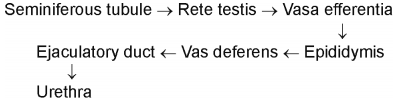
Select the correct pathway of sperms transport.
  1. A Rete testis → Vas deferens → Epididymis → Ejaculatory duct
  2. B Rete testis → Vasa efferentia → Epididymis → Vas deferens
  3. C Vasa efferentia → Rete testis → Epididymis → Ejaculatory duct
  4. D Epididymis → Vas deferens → Vasa efferentia → Ejaculatory duct
Show answer & explanation

Correct answer: B

The extratesticular duct system consists of tubes which conducts sperms from the testes to the outside.
Human Reproduction – NEET-9457
8
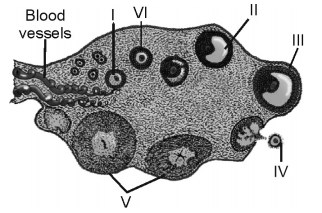
The figure given below depicts a diagrammatic sectional view of ovary. Which one set of three parts out of I-VI are correctly identified?
Human Reproduction – NEET-9580
  1. A VI - Primary follicle; III - Graafian follicle, V - Corpus Iuteum
  2. B II - Secondary follicle; III - Tertiary follicle; IV - Ovulation
  3. C I - Primary follicle; II - Tertiary follicle; V - Corpus Iuteum
  4. D I - Primary follicle; II - Corpus luteum; V - Graafian follicle
Show answer & explanation

Correct answer: C

I - Primary follicle
II - Tertiary follicle showing antrum
III - Graafian follicle
IV - Ovum
V - Corpus luteum
VI - Secondary follicle
* Primary oocyte within the tertiary follicle grows in size and completes its first meiotic division.
9
Which of the following are the derivatives of endoderm?
  1. A Muscles and blood
  2. B Alimentary canal and respiratory organs
  3. C Excretory and reproductive organs
  4. D Skin and nerve cord
Show answer & explanation

Correct answer: B

Muscles, blood and gonads are mesodermal in origin.

Nervous system and epidermis are ectodermal in origin.
10
Signals for parturition originate from
  1. A Foetal oxytocin
  2. B Placenta and fully developed foetus
  3. C Decrease in estrogen to progesterone ratio
  4. D Hormone released from pineal gland
Show answer & explanation

Correct answer: B

Parturition is a complex neuroendocrine process. Ratio of estrogen to progesterone increases during childbirth. Oxytocin is released from maternal posterior pituitary.
11
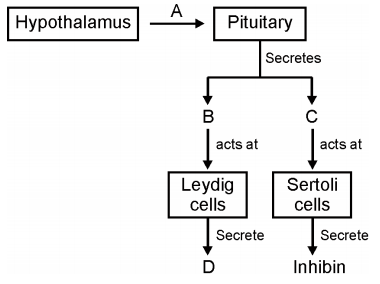
Study the flow chart. Name the hormones labelled as A, B, C, D at each stage.
Human Reproduction – NEET-9573 Choose the correct option.
  1. A
  2. B
  3. C
  4. D
Show answer & explanation

Correct answer: B

GnRH (Gonadotropin releasing hormone) is a hypothalamic hormone, which acts on anterior pituitary that in turn secretes gonodotropins (FSH & LH). LH acts at Leydig cells and stimulates synthesis and secretion of androgens. FSH acts on Sertoli cells and stimulates secretion of some factors which help in the process of spermiogenesis.
12
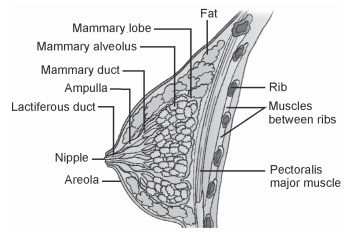
Mammary glands are paired structures that contain the glandular tissue and variable amount of fat. The correct sequence of tissues involved in synthesis and flow of milk is
  1. A Mammary lobes → Mammary alveoli → Mammary ampulla → Mammary duct → Lactiferous duct
  2. B Mammary lobes → Mammary alveoli $\rightarrow$ Mammary duct → Mammary ampulla → Lactiferous duct
  3. C Mammary lobes → Mammary alveoli $\rightarrow$ Lactiferous duct → Mammary ampulla → Mammary duct
  4. D Mammary alveoli → Mammary lobes → Lactiferous duct → Mammary duct
Show answer & explanation

Correct answer: B

Human Reproduction – NEET-9565
13
Androgen binding protein which helps in concentrating testosterone in the seminiferous tubule, is secreted by

  1. A Cells of Leydig
  2. B Sustentacular cells
  3. C Interstitial cells
  4. D Spermatogonial cells
Show answer & explanation

Correct answer: B

Sertoli cells are also known as nurse cells or sustentacular cells. They secrete inhibin.
14
In human beings _____ undergo(es) meiosis II.
Select the option that fills the blank correctly.
  1. A Primary spermatocyte
  2. B Secondary oocyte
  3. C $2 ^ { \text {nd } }$ polar body
  4. D Primary oocyte
Show answer & explanation

Correct answer: B

Primary oocyte and primary spermatocyte enter into $\mathbf { I } ^ { \text {st } }$ meiotic division. ${ } ^ { \text {st } }$ Polar body and secondary oocyte are formed as a result of meiosis $\mathbf { I }$. Second polar body degenerates.
15
Which of the following are mesodermal and endodermal in origin respectively?
  1. A Urinary bladder, Kidney
  2. B Kidney, Inner lining of urinary bladder
  3. C Urinary ducts, Genital ducts
  4. D Genital ducts, Urinary ducts
Show answer & explanation

Correct answer: B

Both urinary and genital ducts are mesodermal in origin.
16
Which layer of uterus undergoes cyclic changes during menstrual cycle in primates?
  1. A Perimetrium
  2. B Myometrium
  3. C Endometrium
  4. D Epimetrium
Show answer & explanation

Correct answer: C

Endometrium of uterus undergoes cyclic changes during menstrual cycle.
17
Which of the following decidua layer forms a partition between developing embryo and lumen at uterus?
  1. A Decidua basalis
  2. B Decidua parietalis
  3. C Decidua capsularis
  4. D Contra deciduate
Show answer & explanation

Correct answer: C

The modified portion of endometrium of uterus upon implantation is called decidua. It sheds when foetus is delivered.

Decidua basalis is part underlying the chorionic vill and overlying myometrium.

Decidua parietalis (= Decidua vera) is the part that lines the uterus at places other than the site of attachment of embryo.

'Contra-deciduate' is that animal in which even the foetal part of placenta is retained and gets absorbed to provide nourishment. Example, Talpa (mole).
18
Which type of placenta is present in the early human embryo?
  1. A Discoidal
  2. B Diffuse
  3. C Zonary
  4. D Cotyledonary
Show answer & explanation

Correct answer: B

Metadiscoidal - diffuse first then discoidal.
19
Type of placenta in the human is
  1. A Chorionic, discoidal, epitheliochorial, deciduate
  2. B Deciduate, hemochorial, diffuse, allantochorionic
  3. C Hemochorial, metadiscoidal, deciduate, chorionic
  4. D Non-deciduate, discoidal, chorionic, hemoendothelial
Show answer & explanation

Correct answer: C

Haemochorial placenta has only three barriers. Maternal part of placenta is completely absent. It occurs in humans, apes, lemurs.

Metadiscoidal - Diffuse first, then discoidal.

Deciduate - A portion of uterine tissue is detached and passed out at birth.

Chorionic - Formed by chorionic villi.
20
Home use kits for determining a women's fertile period depend on the detection of one hormone in the urine. This hormone is
  1. A Progesterone
  2. B Estradiol
  3. C hCG
  4. D LH
Show answer & explanation

Correct answer: D

LH surge occurs during fertile period. LH induces ovulation.

Attempt this as a timed test

Reading answers is not the same as sitting the paper. Attempt it timed and you get your score, per-question timing, and the mistakes tracked for revision.

Start free

More Human Reproduction tests

All Human Reproduction questions & tests →