Molecular Basis Of Inheritance — DPP 3

20 NEET questions from Molecular Basis Of Inheritance, with answers and explanations. Attempt it as a timed test to get scoring, accuracy breakdown and mistake tracking.

Attempt this test free 20 questions · 30 minutes · +80 marks
1
To catalyse the transcription of all types of RNA in bacteria, how many type(s) of DNA-dependent RNA polymerase is/are present in them?
  1. A Two
  2. B Three
  3. C Five
  4. D One
Show answer & explanation

Correct answer: D

Prokaryotes have single RNA polymerase.
2
Human genome project was closely associated with the rapid development of a new area in biology called _______.
  1. A Biotechnology
  2. B Bioinformatics
  3. C Biofortification
  4. D Microbiology
Show answer

Correct answer: B

3
How many locations have been identified in human genome where single base differences occur?
  1. A 1.4 million
  2. B 14 million
  3. C 1.4 billion
  4. D 14 billion
Show answer

Correct answer: A

4
The double helix model for the structure of DNA proposed by Watson and Crick was based on

  1. A Visible light spectrum analysis
  2. B Chromatography
  3. C X-ray diffraction data
  4. D Autoradiography
Show answer & explanation

Correct answer: C

On the basis of X-ray diffraction pictures of DNA, the Watson and Crick proposed a very simple but famous double helix model for the structure of DNA.
5
Mark the correct one (w.r.t. application of DNA fingerprinting)
  1. A Forensic science
  2. B Determining the population diversity
  3. C Determining the genetic diversity
  4. D More than one option is correct
Show answer & explanation

Correct answer: D

(1) and (3)
6
$N$-glycosidic linkages in a polynucleotide chain join
  1. A A nitrogenous base to a pentose sugar
  2. B A nucleotide to a ribose sugar
  3. C A nucleoside to a pentose sugar
  4. D A phosphate group to a nucleoside
Show answer & explanation

Correct answer: A

A nitrogenous base is linked to a pentose sugar by N-glycosidic linkage.
7
DNA polymerases catalyse polymerisation of/in
  1. A Ribonucleotides
  2. B $5 ^ { \prime } \rightarrow 3 ^ { \prime }$ direction
  3. C $3 ^ { \prime } \rightarrow 5 ^ { \prime }$ direction
  4. D Deoxyribonucleosides
Show answer & explanation

Correct answer: B

$\mathbf { 5 } ^ { \prime } \longrightarrow 3$ Polymerisation
8
Dominance of RNA world is proved by
  1. A Capping
  2. B Splicing
  3. C Polyadenylation
  4. D All of these
Show answer

Correct answer: B

9
In a nucleotide, a phosphate group is linked to (i) of a nucleoside through (ii).
Select the correct option to fill in the blanks (i) and (ii).
  1. A (i) OH of $3^{\prime} \mathrm{C}$, (ii) Hydrogen bond
  2. B (i) OH of $5^{\prime} \mathrm{C}$, (ii) Phosphoester linkage
  3. C (i) $3^{\prime}-\mathrm{C}$, (ii) Peptide bond
  4. D (i) OH of $5^{\prime} \mathrm{C}$, (ii) Glycosidic linkage
Show answer & explanation

Correct answer: B

In a nucleotide, a phosphate group is linked to OH of $5^{\prime} \mathrm{C}$ of nucleoside. When a phosphate group is linked to OH of $5^{\prime} \mathrm{C}$ of a nucleoside through phosphoester linkage, a corresponding nucleotide is formed.
10
A. The nascent RNA synthesised by RNA polymerase II is called hnRNA.
B. Splicing is the process of removal of introns and joining of exons in a defined order.
  1. A Only A is correct
  2. B Both A and B are incorrect
  3. C Only B is correct
  4. D Both A and B are correct
Show answer

Correct answer: D

11
In prokaryotic translation, the formation of peptide bond between two amino acids is catalysed by a
  1. A Proteinaceous enzyme
  2. B Lysozyme
  3. C RNA catalyst
  4. D Ribonuclease
Show answer & explanation

Correct answer: C

During translation, formation of peptide bond is catalysed by peptidyl transferase. Peptidyl transferase is a ribozyme (RNA enzyme) or RNA catalyst.
12
Polymorphism in DNA sequence is the basis of which of the following?
(a) Genetic mapping of human genome
(b) DNA fingerprinting
(c) Similarities among human beings
  1. A Only (a)
  2. B Only (b)
  3. C Only (a) and (b)
  4. D Only (b) and (c)
Show answer & explanation

Correct answer: C

Polymorphism in DNA sequence is the basis of DNA fingerprinting as it is unique to every individual as well as basis for genetic mapping of human genome too.
13
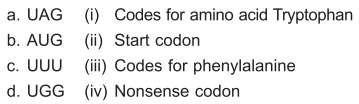
Match the following columns and select the correct option.
Molecular Basis Of Inheritance – NEET-10046
  1. A
  2. B
  3. C
  4. D
Show answer & explanation

Correct answer: C

Nonsense codon is stop codon, i.e., UAG. Start codon is AUG. UGG codes for amino acid Tryptophan. UUU codes for phenylalanine.
14
Select true (T) or false (F) for the following statements and choose the correct option.
A. QB bacteriophage has RNA as genetic material.
B. Free $2^{\prime} \mathrm{OH}$ of RNA makes it more labile and easily degradable.
C. The experiment of Hershey and Chase gave unequivocal proof that DNA is the genetic material.
  1. A
  2. B
  3. C
  4. D
Show answer & explanation

Correct answer: C

RNA has free 2'OH in sugar of every nucleotide but in DNA it is not found. Hence RNA is easily degradable as compared to DNA.
The experiment of Hershey and Chase proved clearly that DNA is the genetic material. They used isotopes of phosphorus and sulphur for their experiments. QB bacteriophage is a RNA virus.
15
Identify the incorrect difference between prokaryotic and eukaryotic transcription.
  1. A
  2. B
  3. C
  4. D
Show answer & explanation

Correct answer: D

hnRNA is converted into functional m-RNA by post transcriptional process. Post transcriptional modifications involve splicing, capping and tailing which are absent in prokaryotes but are found in eukaryotes.
Splicing occurs in nucleus in eukaryotes whereas in prokaryotes it is absent as introns are absent except in Archaebacteria.
16
Mark the wrong statement.
  1. A In prokaryotes, transcription and translation occur in the different compartments
  2. B In eukaryotes, usually structural gene of transcription unit is monocistronic
  3. C In prokaryotes, the mRNA is produced in the cytoplasm
  4. D In eukaryotes, the primary transcript undergoes splicing
Show answer & explanation

Correct answer: A

In prokaryotes both transcription and translation occur in the cytoplasm only.
17
Monocistronic structural genes are found mostly in
  1. A Bacteria
  2. B Blue-gree algae
  3. C Monerans
  4. D Eukaryotes
Show answer & explanation

Correct answer: D

Eukaryotes have monocistronic structural genes.
18
Read the following statements and choose the correct one(s).
A. During DNA replication, Adenine pairs with Uracil
B. Chargaff's rule is applicable only for double stranded DNA.
C. The area with long sequence of short repetitive DNA is called satellite DNA.
  1. A A and B
  2. B B and C
  3. C Only B
  4. D Only C
Show answer & explanation

Correct answer: B

Replication is copying of DNA. In DNA Uracil is absent, it is present in RNA. Chargaff's rule is not applicable for single stranded DNA. Repetitive DNA is the part of DNA which contains the same sequence of nitrogen bases repeated more than once in a genome and the area with long sequence of short repetitive DNA is called satellite DNA.
19
In DNA fingerprinting, detection of hybridised DNA fragments is possible by
  1. A Electrophoresis
  2. B Blotting
  3. C Autoradiography
  4. D Centrifugation
Show answer & explanation

Correct answer: C

By taking radioactive isotops.
20
The existence of complementarity with DNA is not seen during the process of
  1. A Replication
  2. B Reverse transcription
  3. C Translation
  4. D Transcription
Show answer & explanation

Correct answer: C

Translation is synthesis of polypeptide according to codons present on m-RNA which does not follow rule of complementarity.

Attempt this as a timed test

Reading answers is not the same as sitting the paper. Attempt it timed and you get your score, per-question timing, and the mistakes tracked for revision.

Start free

More Molecular Basis Of Inheritance tests

All Molecular Basis Of Inheritance questions & tests →